
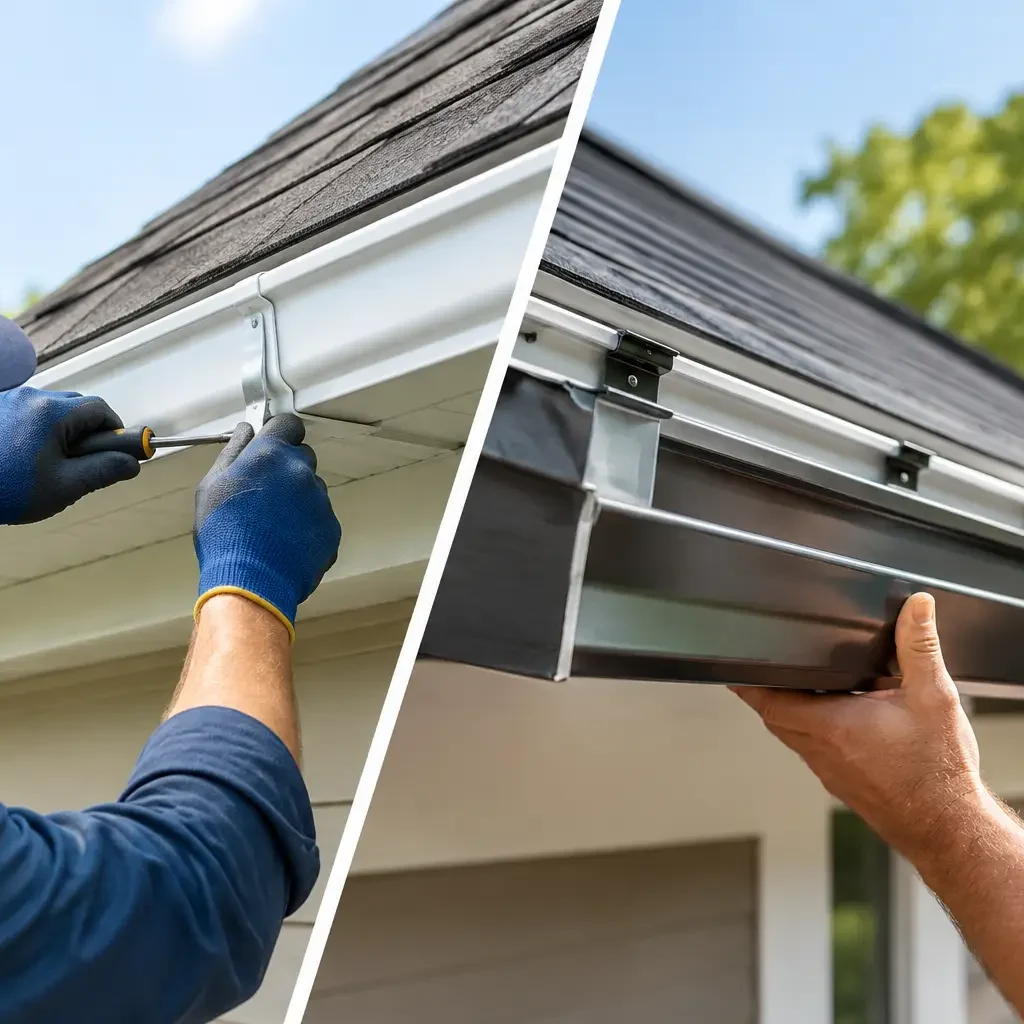
A gutter that drips at one joint may be a modest repair. A gutter line pulling away from the fascia, overflowing in several locations, and staining the exterior is a different capital decision. Understanding gutter repair vs replacement costs helps property owners avoid spending repeatedly on short-term fixes when the underlying drainage system has reached the end of its useful life.
The right choice is not always the least expensive option on the first invoice. It depends on the extent of damage, the gutter material, roof geometry, access requirements, and whether water has already affected the roof edge, soffit, fascia, siding, or foundation. A careful assessment turns a seemingly minor maintenance issue into a clear scope, budget, and long-term plan.
Gutter Repair vs Replacement Costs: Typical Ranges
For a single localized issue, gutter repair commonly falls between $150 and $600. This may include resealing leaking seams, replacing a damaged downspout section, resetting loose hangers, correcting a small pitch issue, or patching a limited area of metal. Costs rise when the work requires tall ladders, complex roof access, specialty materials, or repair to concealed wood behind the gutter.
Full replacement is a broader exterior project. Many residential gutter replacements range from roughly $1,500 to $5,000, while larger homes, premium materials, complex rooflines, multistory access, and integrated drainage improvements can move the investment higher. Commercial properties are priced according to linear footage, building height, drainage design, material specification, safety requirements, and coordination with roof and facade systems.
These ranges are planning figures, not a substitute for a site-specific proposal. Labor rates, local code requirements, disposal, permit needs, and the condition of adjacent components can change the final cost substantially. The most reliable estimate identifies what is included beyond the gutter itself: downspouts, hangers, flashing adjustments, fascia repairs, splash blocks or drain extensions, cleanup, and warranty coverage.
When Repair Is the Sensible Investment
Repair is generally the right path when damage is isolated and the existing system remains structurally sound. A small seam leak, one dented section after a storm, a disconnected downspout, or several failing hangers can often be corrected without replacing the entire run.
Age matters, but condition matters more. A relatively older gutter system that has been maintained, drains properly, and shows no widespread corrosion or deformation may still justify targeted repairs. This is especially true when the existing gutters match a historic facade or were recently integrated with a roofing or exterior renovation.
The value of a repair depends on whether it addresses the cause, not only the visible symptom. For example, water spilling over one section might result from debris, insufficient downspout capacity, an incorrect gutter slope, or an upper roof valley directing too much water into one point. Sealing the seam without correcting the drainage load may only postpone the next service call.
A well-scoped repair should confirm that water is moving toward the downspouts, discharging away from the building, and not entering the roof edge or wall assembly. On investment properties and commercial sites, this assessment is particularly valuable because recurring leaks can affect tenant spaces, exterior finishes, and maintenance budgets.
Signs Replacement Will Cost Less Over Time
Replacement becomes more economical when repairs are frequent, defects occur across multiple sections, or the gutter system no longer has the structural capacity to perform as intended. Multiple leaks, widespread rust, recurring separations at joints, sagging runs, cracked vinyl, and loose sections along the fascia are common indicators.
Pay close attention to the condition behind the gutter. Rotting fascia boards, deteriorated soffits, peeling paint near the roofline, and staining on masonry or siding suggest that water has been bypassing the drainage system for some time. In these cases, installing new gutters without addressing damaged substrate can conceal a more expensive problem and compromise the new installation.
Replacement also creates an opportunity to correct design limitations. Older systems may be undersized for the roof area, have too few downspouts, or discharge water too close to the foundation. A properly designed replacement can improve capacity, reduce overflow at valleys, and direct runoff to suitable drainage areas. That can protect landscaping, hardscapes, foundations, and lower-level spaces from avoidable water exposure.
For owners planning a roof replacement, exterior repainting, siding work, or a comprehensive renovation, coordinating gutter replacement within the larger project often improves both execution and cost control. Trades can sequence work correctly, protect finishes, and address flashing and fascia conditions before final installation.
What Drives the Difference in Cost
Material selection is one of the most visible cost variables. Vinyl systems are typically lower in initial cost but can become brittle in extreme temperatures and may not suit every architectural standard. Aluminum is widely used because it is lightweight, corrosion-resistant, and available in seamless configurations. Steel offers strength but needs appropriate protective coatings. Copper carries a premium price and is often selected for distinctive architectural character and long service life.
Seamless gutters usually cost more than sectional products at installation, but they reduce the number of joints where leaks can develop. They are fabricated to fit the building, making them a practical choice for many properties where long-term maintenance and a clean appearance matter.
Access and complexity also influence the proposal. A simple single-story home with straight roof runs requires far less labor than a multistory property with steep pitches, numerous corners, enclosed courtyards, or limited equipment access. High-end exterior finishes may require additional protection and careful detailing. If fascia repair, roof-edge flashing, or wood replacement is necessary, those items should be separated clearly in the scope rather than treated as vague contingencies.
Drainage improvements can add cost but often deliver the strongest long-term value. Larger downspouts, additional leaders, leaf protection, underground connections, and properly designed discharge extensions may prevent overflow and soil erosion. These features should be chosen based on the building and site conditions, not added as standard upgrades without a clear performance reason.
How to Compare Proposals With Confidence
A low number can be appealing, but gutter work is only as reliable as the diagnosis, materials, attachment method, and water-management details behind it. Compare proposals on equivalent scopes. Confirm the linear footage, material gauge or specification, gutter size, number and size of downspouts, hanger spacing, fascia repairs, disposal, and warranty terms.
Ask whether the contractor will test drainage after installation and how they will handle unexpected deterioration discovered when existing gutters are removed. A transparent proposal distinguishes between included work and conditions that may require authorization. This protects the owner from unclear allowances and helps preserve budget predictability.
For a larger property or a renovation with several exterior trades, centralized project coordination reduces the risk of gaps between scopes. Roofing, carpentry, painting, masonry, drainage, and landscaping can all affect gutter performance. KSB approaches these decisions with the broader building envelope in view, helping clients align immediate repairs with the property’s long-term maintenance and improvement plan.
A Practical Decision Framework
Before approving repair or replacement, consider three questions. First, is the problem isolated or recurring across the system? Second, is the gutter itself failing, or is the building directing more water than the current layout can manage? Third, are there related exterior projects that should be coordinated now to avoid rework later?
If the system is fundamentally sound and the issue is localized, a targeted repair is usually a responsible use of funds. If there is widespread deterioration, hidden wood damage, inadequate capacity, or repeated maintenance expense, replacement offers a more predictable long-term outcome. The decision should be based on total ownership cost, not only the initial price.
Water management rarely draws attention when it works properly, which is exactly the point. A clear inspection, a defined scope, and a drainage solution matched to the building can protect far more than the gutter line – it can protect the value and condition of the property beneath it.