
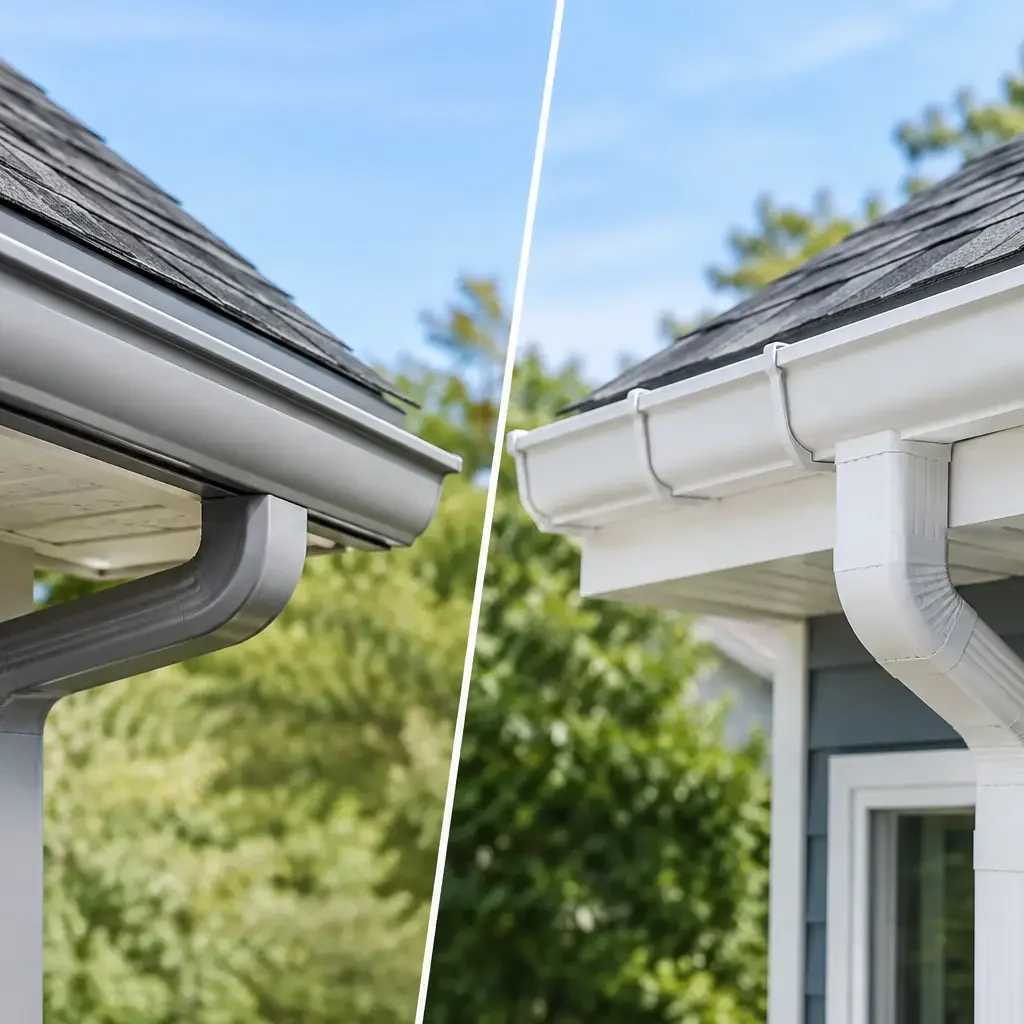
Water management is one of the least visible systems protecting a building, yet a poorly planned gutter installation can create highly visible consequences: stained facades, damaged landscaping, foundation moisture, and premature deterioration of exterior finishes. When comparing seamless gutters vs sectional gutters, the right choice depends on more than the initial estimate. The roofline, drainage volume, architectural details, maintenance expectations, and long-term plans for the property all matter.
For homeowners, investors, and commercial property decision-makers, gutters should be evaluated as part of the full exterior envelope. A reliable system directs water away from the building consistently, supports the condition of the roof and siding, and reduces avoidable repair work over time.
How the Two Gutter Systems Differ
Sectional gutters are assembled from pre-cut lengths joined together along the roof edge. The sections are commonly available in vinyl, aluminum, steel, and other materials. Because they are sold in standardized lengths, they can be transported easily and installed on a wide range of buildings.
Seamless gutters are formed on site from a continuous coil of metal, typically aluminum, to match the dimensions of each roof edge. They still require connections at corners, outlets, and end caps, but there are no joints along straight runs. This distinction is the central performance difference between the two options.
Neither system is automatically appropriate for every property. A compact outbuilding with short roof runs may perform well with sectional components. A larger residence, a custom renovation, or a commercial building with long elevations will often benefit from a system tailored to the structure.
Seamless Gutters vs Sectional Gutters: Performance
The primary advantage of a continuous-run system is the reduced number of joints. Every joint in a gutter is a potential location for debris accumulation, sealant failure, and leakage. Fewer connections generally mean fewer points that need inspection and repair.
This matters most on long, straight rooflines. Rainwater gathers speed and volume as it travels toward a downspout, especially during heavy storms. If a joint begins to separate or the sealant deteriorates, water can run behind fascia boards or spill onto the ground directly next to the foundation. Over time, a small issue can affect painted trim, soffits, exterior cladding, and surrounding hardscape.
Sectional gutters can perform reliably when they are installed with correct slope, adequate hanger spacing, properly sealed joints, and appropriately sized downspouts. Their limitation is not that they are inherently poor products. Rather, they require more joint maintenance over their service life. For properties where access is straightforward and periodic maintenance is expected, this may be an acceptable trade-off.
A continuous-run system also tends to present a cleaner exterior appearance. Long, uninterrupted lines suit contemporary homes, high-end renovations, and commercial facades where exterior details are part of the property’s overall presentation. Color-matched metal options can integrate well with roofing, trim, and architectural metalwork.
Cost: Initial Budget and Long-Term Value
Sectional gutters typically have a lower upfront material and installation cost. Standard pieces can be purchased quickly, and smaller repairs are often manageable because an individual damaged section can be replaced. This can make them a practical option for modest projects, detached structures, rental properties, or temporary improvements.
Seamless gutters usually cost more at installation because they require specialized equipment, accurate site measurement, and professional fabrication. The higher initial expense is often justified by fewer joints, a more customized fit, and reduced likelihood of joint-related maintenance. It is best understood as a long-term value decision rather than a simple material upgrade.
The lowest installation quote is not always the lowest ownership cost. A gutter system that repeatedly leaks, pulls away from the fascia, or overflows in heavy rain can lead to costs far beyond gutter repair. When reviewing proposals, decision-makers should consider the full scope: removal of existing gutters, fascia condition, flashing needs, downspout placement, discharge extensions, repairs to drainage areas, and final cleanup.
Installation Quality Has a Greater Impact Than Many Owners Expect
Even high-quality gutters will underperform if the installation is poorly planned. The gutter must be pitched correctly toward downspouts, securely fastened to sound framing, and sized for the roof area and local rainfall conditions. Downspouts must then discharge water a safe distance from the foundation or connect to a properly designed drainage solution.
Roof geometry also affects the installation approach. Valleys concentrate large volumes of water in a limited area. Upper roofs can discharge onto lower roof sections. Dormers, curved transitions, and concealed drainage details may require custom fabrication or additional water-control measures. A standard layout may not be enough for a complex residence or a commercial property with multiple roof levels.
Before selecting either system, inspect the fascia and soffit conditions. Rotting wood, loose trim, and inadequate flashing should be corrected before new gutters are installed. Installing new components over deteriorated substrate may conceal an issue temporarily while making a more extensive repair likely later.
For renovation projects, gutter work should also be coordinated with roofing, siding, painting, exterior lighting, and landscape drainage. Coordinated sequencing protects finished work and prevents a new system from being removed or altered when adjacent improvements begin.
Material Choices and Maintenance Requirements
Aluminum is widely used because it is lightweight, corrosion-resistant, and available in many colors. It is well suited to most residential applications, although it can dent if struck by ladders or falling branches. Steel offers greater impact resistance but needs a durable protective finish to prevent corrosion. Copper provides a distinctive architectural finish and exceptional longevity, but it carries a significantly higher cost and requires experienced installation.
Vinyl sectional gutters are economical and resist corrosion, but they can become brittle in severe cold and may expand or contract more noticeably with temperature changes. Their appearance and longevity may be less suitable for premium properties or buildings exposed to intense sun and demanding weather conditions.
Regardless of material, all gutters need maintenance. Leaves, seed pods, roofing granules, and nesting debris can obstruct water flow. At minimum, gutters and downspouts should be inspected after major storms and cleaned on a regular schedule based on nearby tree coverage. Gutter guards can reduce debris accumulation, but they do not eliminate the need for inspection. Their effectiveness depends on the guard design, roof type, and types of debris common to the site.
Choosing the Right System for the Property
A sectional system can be a sound choice when the roofline is simple, budget is the priority, and the owner accepts more frequent inspection of joints. It can also make sense where only a short section needs replacement or where a basic drainage upgrade is needed for a secondary structure.
A continuous-run system is often the stronger investment for primary residences, custom homes, extensive renovations, and commercial properties where appearance, durability, and reduced maintenance risk are priorities. It is particularly valuable on long roof runs and in locations with heavy rainfall, dense tree cover, or limited access for recurring maintenance.
The decision should also account for future ownership plans. An owner preparing a property for sale may prioritize a clean, reliable exterior improvement with clear visual appeal. A long-term owner may place more value on minimizing maintenance points and protecting the building envelope over decades. For an investor, the best option may be the one that reduces recurring service calls and protects the asset’s operating condition.
Questions to Ask Before Approving a Gutter Proposal
A thorough proposal should explain the gutter material, profile, thickness, color, hanger method, downspout size, and outlet locations. It should also identify whether fascia repairs, roof flashing work, removal and disposal, or drainage extensions are included. Vague scopes often create change orders after work begins.
Ask how the installer will manage roof valleys and high-volume areas, how water will be directed away from the foundation, and what warranty applies to both materials and workmanship. For larger projects, it is also reasonable to request that gutter installation be coordinated with the broader exterior scope so that drainage, finish work, and landscaping function together.
A gutter system is a relatively small part of a building project, but it has a direct role in protecting far more expensive components. The right choice is the one that fits the property’s drainage demands, architectural standard, and maintenance plan – then is installed with the same care given to the rest of the exterior.